Tuesday, July 12, 2016

The Loss of Trust

Our successful American democratic republic has primarily rested on the trust of the majority of the general public.  That is to say, if the majority of the public disobeyed laws, all enforcement mechanisms would be rendered impotent.  I felt that trust in our government was earned when President Richard M. Nixon was impeached and forced to resign over the Watergate Scandal, proving that we have a nation of laws that apply to all; that was a high point in American history, which the entire world admired.


Unfortunately, today, we have a low point in our history when the Attorney General holds an unethical secret meeting and dismisses it as chit chat, when the FBI Director denies the obvious and demands credence, and when a secretary of state mismanages American secrets and makes jokes about erasing thousands of emails from public records.  It is hard to trust that we still have a nation of laws that apply to all and even harder to trust those who demand that we do.


Visit my website at www.CarlosArce.net


Monday, July 11, 2016

June 24, 2016

The Shame of American Criminal Justice: Prison Madness

What do we know about jails and prisons?  We all seem to know, or at least suspect, that incarcerated persons undergo horrible experiences behind bars; they do.  There are close to two and half million people in federal and state prisons and local jails, far more than any other country.  The poor are overrepresented in the inmate population, especially those who are suffering from mental illness and drug addiction.  In many ways, our jails and prisons are warehouses for these populations, while institutions for the mentally ill are in short supply, and addiction treatment centers are poorly funded.  Starting in the 1980s and continuing to the present day, tough drug enforcement laws have flooded our jails and prisons with convicted offenders; the overcrowding has become insufferable.    

Who goes to prison?  Mostly the poor who lack the resources, both for bail and for a proper defense.  Other reasons stem from discriminating legislation, for example, the different treatment of powder cocaine, used by the wealthy, and crack cocaine, the cheaper version used by the poor.  The latter is actively pursued by the police and carries mandatory prison for small amounts (28 grams).  Power cocaine is often not on the police radar, and prison requires a violation involving very large amounts (500 grams).   Some argue that the creation of for-profit administration of prisons is behind the increase in incarcerated persons, and there is probably some degree of corruption in this area as well.

What happens once in prison?  A phrase attributed to inmates suggests that newcomers to the inmate population are either Vikings or victims.  That is to say that if you are not tough and strong, you will be a slave; you will be continuously raped and frequently beaten. If you can fight your way out of slavery, then you must join one of the prison gangs and be always at war.  Since there is only one jail or prison guard per hundreds of inmates, guards are usually on the other side of the bars, and inmates run the prison blocks and yards.  It is believed by many that official corruption is significant and everything is for sale.

What happens to inmates after jail or prison?  Rehab programs are poorly funded and inefficiently run inside, so employment opportunities outside are usually beyond their reach.  The poor transition leads to a much higher recidivism rate than it needs to be.


How can it be made better? It will require more funding for additional security personnel, anti-corruption mechanisms, and rehabilitation efforts, including work-release programs, as well as other diversion programs.  It is not rocket science, but it does not happen when only the poor are imprisoned, and the middle and upper classes have to foot the bill.  Plainly speaking, there is no voting constituency.  Proportional bail and uniform enforcement of drug laws would be an offer the middle and upper American classes can't refuse.


Visit my website:  www.CarlosArce.net


Saturday, June 25, 2016

June 24, 2016

The Shame of American Criminal Justice: Abusive Courts

             On paper, the American Constitution, within its first 10 amendments, known as the "Bill of Rights," guarantees citizens the right to a trial by jury and protection against "cruel and unusual punishment."  Later, in the 14th Amendment, the Constitution provides that citizens cannot be deprived of their life, liberty, or property without "due process of law."  Although not specifically stated, it is also implied in three amendments, the 5th, 6th, and the 14th, that an accused is considered innocent until proven guilty.  These are among the legal protections that provide a foundation for democracies.  While a defendant is awaiting trial, American courts provide for an elaborate system of bail, which allows those individuals to deposit money or property in the court's holding to guarantee against their flight.  The system is great for the middle and upper classes and for the Bail/Bond Commercial Industry; it is different for the poor.
             A judge can deny bail and order pre-trial detention in cases of capital crimes if there is a high risk of flight or if the defendant is considered dangerous to the community.  However, in most cases, a middle-class or upper-class person is able to post bail and remain free until the trial.  For a poor person, bail is set at the same amount depending on the offense, not on the means of the defendant.  Thus, a system of pre-trial detention forces masses of poor people behind bars for many months while they wait for their turn in overloaded court systems.  The tragedy is that "detention centers" are not much different from regular prisons, and detained defendants, innocent and guilty alike, are thrown into the general inmate population.  It is common knowledge that an individual becoming a general population inmate must be a "Viking or a victim;" for the weak, it means a life of rape and enslavement.  It is a clear case of "justice delayed equals justice denied."  I experienced this firsthand during the years that I worked as a teacher and counselor inside the prisons of New York City's Rikers Island.  The bulk of these cases are resolved through a system of "plea bargain," where detained defendants, after months of incarceration, are offered the choice to plead guilty to a lesser charge and be sentenced to "time served," with immediate release.  Otherwise, their inexperience, the Legal Aid Society, a court-appointed attorney, tells them that they can wait more time behind bars to go to trial and then risk a long sentence.  It is an offer few can refuse.
             If this type of "plea bargain" system were to be eliminated, the court system would be overwhelmed; it would collapse.  The possible solutions are additional funding for more courts and personnel, running existing courthouses on a 24/7 schedule, and the introduction of lower-salary magistrates to take lesser offense cases away from high-salary judges.  A simple way to convince the public to accept the higher cost of these reforms would be to restructure the bail system so as to set bail based on means to pay.  Hence, masses of middle and upper-class defendants would experience a stay in detention centers for non-capital crimes.  Of course, while most of us are insulated from a stay in the hell of prison, it is easier to continue to keep the plight of the poor out of sight and out of mind.  Is this the America we want?


Visit my website at www.CarlosArce.net


June 24, 2016

The Shame of American Criminal Justice: Abusive Courts

             On paper, the American Constitution, within its first 10 amendments, known as the "Bill of Rights," guarantees citizens the right to a trial by jury and protection against "cruel and unusual punishment."  Later, in the 14th Amendment, the Constitution provides that citizens cannot be deprived of their life, liberty, or property without "due process of law."  Although not specifically stated, it is also implied in three amendments, the 5th, 6th, and the 14th, that an accused is considered innocent until proven guilty.  These are among the legal protections that provide a foundation for democracies.  While a defendant is awaiting trial, American courts provide for an elaborate system of bail, which allows those individuals to deposit money or property in the court's holding to guarantee against their flight.  The system is great for the middle and upper classes and for the Bail/Bond Commercial Industry; it is different for the poor.
             A judge can deny bail and order pre-trial detention in cases of capital crimes if there is a high risk of flight or if the defendant is considered dangerous to the community.  However, in most cases, a middle-class or upper-class person is able to post bail and remain free until the trial.  For a poor person, bail is set at the same amount depending on the offense, not on the means of the defendant.  Thus, a system of pre-trial detention forces masses of poor people behind bars for many months while they wait for their turn in overloaded court systems.  The tragedy is that "detention centers" are not much different from regular prisons, and detained defendants, innocent and guilty alike, are thrown into the general inmate population.  It is common knowledge that an individual becoming a general population inmate must be a "Viking or a victim;" for the weak, it means a life of rape and enslavement.  It is a clear case of "justice delayed equals justice denied."  I experienced this firsthand during the years that I worked as a teacher and counselor inside the prisons of New York City's Rikers Island.  The bulk of these cases are resolved through a system of "plea bargain," where detained defendants, after months of incarceration, are offered the choice to plead guilty to a lesser charge and be sentenced to "time served," with immediate release.  Otherwise, their inexperience, the Legal Aid Society, a court-appointed attorney, tells them that they can wait more time behind bars to go to trial and then risk a long sentence.  It is an offer few can refuse.
             If this type of "plea bargain" system were to be eliminated, the court system would be overwhelmed; it would collapse.  The possible solutions are additional funding for more courts and personnel, running existing courthouses on a 24/7 schedule, and the introduction of lower-salary magistrates to take lesser offense cases away from high-salary judges.  A simple way to convince the public to accept the higher cost of these reforms would be to restructure the bail system so as to set bail based on means to pay.  Hence, masses of middle and upper-class defendants would experience a stay in detention centers for non-capital crimes.  Of course, while most of us are insulated from a stay in the hell of prison, it is easier to continue to keep the plight of the poor out of sight and out of mind.  Is this the America we want?


Visit my website at www.CarlosArce.net


Wednesday, June 22, 2016

The Shame of American Criminal Justice: Police Abandonment

It has been universally recognized that protection from foreign invasion and from criminals at home is the primary function and duty of government and the paramount justification for its existence. In America today, the threat of foreign invasion is unthinkable, but domestic tranquility is far from universally guaranteed. For upper and middle classes, American police protection is superb by any standard, but for the poor, it is not.
Poor neighborhoods have many more criminals living in them, and a frightening percentage of residents there have been through the criminal schools in our prisons, many with advanced degrees, so to speak.  Criminologists have traditionally suggested that flooding those neighborhoods with police presence would only displace crime.  Yet, that is a great idea; when criminals are displaced to wealthy neighborhoods to practice their trade, residents there will pay to flood their neighborhoods with police presence.  The problem is that wealthy citizens do not want to pay for the cost of flooding poor neighborhoods with police presence to control crime while they remain unaffected by it within their comfort and wealth.
The poor neighborhoods in Chicago and many other major cities resemble war zones.  Gangs rule the streets and the schools, and the ubiquitous response from our political leaders is always the same, "there is nothing that can be done” other than to increase the funding of anti-poverty programs.  The Great Society programs begun in the 60's have cost $trillions and it is hard to notice it.  Local political leaders have often used the funding to build their own electoral machines, public-funded, social-service delivery organizations that employ their loyal ground-game workers.  Some even work in partnership with neighborhood drug gangs, as well as with corrupt police gangs.
Can this change?  Anything can be changed with enough political will.  Street gangs have to be confronted as the terrorist organizations that they are with brute force.  Violent neighborhoods need to be flooded with police forces, with as many minority members as possible within them, but sufficient to reestablish order.  Police officers working in anti-drug units should be scrutinized in the same way that we filter agents for the Secret Service, FBI, and CIA; there is a great deal of corruption in these local forces, and drugs are destroying the fabric of society in these forgotten segments of our nation.  The route out of poverty is good education, which, first of all, requires discipline,  accountability, and a safe neighborhood.

Visit my website at www.CarlosArce.net


The Shame of American Criminal Justice: Police Abandonment

It has been universally recognized that protection from foreign invasion and from criminals at home is the primary function and duty of government and the paramount justification for its existence. In America today, the threat of foreign invasion is unthinkable, but domestic tranquility is far from universally guaranteed. For the upper and middle classes, American police protection is superb by any standard, but for the poor, it is not.
Poor neighborhoods have many more criminals living in them, and a frightening percentage of residents there have been through the criminal schools in our prisons, many with advanced degrees, so to speak.  Criminologists have traditionally suggested that flooding those neighborhoods with police presence would only displace crime.  Yet, that is a great idea; when criminals are displaced to wealthy neighborhoods to practice their trade, residents there will pay to flood their neighborhoods with police presence.  The problem is that wealthy citizens do not want to pay for the cost of flooding poor neighborhoods with police presence to control crime while they remain unaffected by it within their comfort and wealth.
The poor neighborhoods in Chicago and many other major cities resemble war zones.  Gangs rule the streets and the schools, and the ubiquitous response from our political leaders is always the same, "there is nothing that can be done” other than to increase the funding of anti-poverty programs.  The Great Society programs begun in the 60's have cost $trillions and it is hard to notice it.  Local political leaders have often used the funding to build their own electoral machines, public-funded, social-service delivery organizations that employ their loyal ground-game workers.  Some even work in partnership with neighborhood drug gangs, as well as with corrupt police gangs.
Can this change?  Anything can be changed with enough political will.  Street gangs have to be confronted as the terrorist organizations that they are with brute force.  Violent neighborhoods need to be flooded with police forces, with as many minority members as possible within them, but sufficient to reestablish order.  Police officers working in anti-drug units should be scrutinized in the same way that we filter agents for the Secret Service, FBI, and CIA; there is a great deal of corruption in these local forces, and drugs are destroying the fabric of society in these forgotten segments of our nation.  The route out of poverty is good education, which, first of all, requires discipline,  accountability, and a safe neighborhood.


Tuesday, June 21, 2016

Is There a Donald Trump Secret Majority?


One wonders how Trump has won the Republican Party nomination while so few people seem to publicly proclaim to be ready to vote for him.  Has it been an exercise of reactive choice and suspended judgment?  I dare suspect that there is a "secret majority" of voters in the Republican Party and perhaps beyond who desperately hope for radical change in key areas of government policy but are intimidated into silence by a wave of boisterous repulsion by the American mainstream media.  For Mr. Trump's public and secret supporters, his inartful policy statements are a small price to pay in exchange for the anticipated certainty of his promises of draconian transformation of current government rule.  In his crude way, Mr. Trump is rekindling hope for those who yearn for the days of nearly balanced budgets, unperceivable undocumented immigration, trade surpluses, energy sufficiency, near full employment, secured homeland, predictable social mores...  The media is the message, but will its relentless demonization of the self-funded champion of the dream suffice to prevent the covert revolt?


Visit my website at www.CarlosArce.net

Monday, May 23, 2016

May 23, 2016

Transcending Energy Dependence


The debate over the use of fossil fuels and its effects on global warming tends to polarize American political factions, between those who would wage war on coal, oil, and natural gas and those who favor the "all of the above" solution.  Ideally, the goal of a clean energy world will be reached in the future to arrest global warming. It behooves America to be a world leader in this effort; by most accounts, the U.S. is responsible for some 20% of the world's air pollution.  Nevertheless, other growing nations like Brazil, Russia, India, and China (BRIC), together with economic powerhouses like Japan, Germany, and England, far surpass America in the emission of global warming pollution.

Unilateral industrial disarmament is not the prudent course of action for America; instead, a gradual, multi-step energy transition offers the most sense.  The first step should be an aggressive exploit of American huge natural gas reserves, with the initial intent of replacing the use of diesel in all trucks and buses on U.S. roads.  T. Boone Pickens, the Texan oil tycoon, proposed this, along with other measures, over a decade ago, explaining that this move alone could eliminate the import of foreign oil.  American natural gas could also gradually replace the use of coal for electricity generation, while improvements in clean coal and coal gasification technologies could keep many coal miners at work; others will need retraining and reemployment.  An unleashed American energy sector would produce enough natural gas to supply our national needs, as well as to make America the greatest energy exporter in the world.  An abundance of natural gas would lower its price to the point of our competing oil and coal without tinkering with the free market system.  This logical transition from coal and diesel to natural gas would yield enormous benefits in pollution reduction, job creation, and balance of trade improvements.

A second step in the energy transition scheme is the development of concentric nuclear energy generation.  America has fallen behind in the development of this important source of energy since the near meltdown of the Three Mile Island Nuclear Plant in 1979, which was closely followed by the Chornobyl Nuclear Plant disaster of 1986 in the old Soviet Union.  Most recently, the nuclear power issue has been withdrawn from the planning table following the 2015 Fukushima Daiichi nuclear disaster in Japan, which was caused by a Tsunami.  The concept of concentric nuclear power development I propose here would involve the construction of many nuclear plants with inter-connected and redundant water pumps, water storage, and electric generation emergency systems.  Thus, any overheating reactor could garner the cooling system resources of relatively nearby, interconnected sister plants.  Projects involving hundreds of square miles in remote locations in the country and the creation of electric transmission networks would bring massive economic development to those regions of the country.  While their remote locations would minimize risk and public opposition.  The issue of nuclear waste will eventually be solved by space ferrying systems to expel this material from Earth.   

The third step in our quest for energy independence would be the concentric development of wind power centers in fertile locations where natural rivers of wind have always existed, like in the central plains and offshore on the northeast coast of our country. Solar power and a myriad of low-tech energy projects would also gush throughout the nation once energy companies are forced to purchase citizens' developed electric power.

One day, not far into the future, electric cars, hydrogen fuel cells... and ultimately fusion power with the use of helium III mined on the moon will create an energy-rich environment for all.  However, today, America need not be energy dependent, nor poor and indebted anymore.


For more information visit my website at www.CarlosArce.net

Sunday, May 8, 2016

Keeping the Eye on the Political Ball

More often than not, our average voter concentrates on the charisma or distastefulness of political candidates while losing sight of crucial issues.  In simple terms, our nation displays a polarized view on a number of key issues:  Do we need a balanced budget amendment, or can we continue to increase the national debt?  Do we stop undocumented immigration and then grant amnesty, or grant amnesty and then stop undocumented immigration?  Is the answer to inferior education more money or school choice?  Do we use natural gas to gain energy self-sufficiency and a cleaner environment, or ban fracking?  Do we first demand a level playing field in international trade or continue to sign free-trade agreements?  On and on, to be or not to be, that is the question?  


Tuesday, May 3, 2016

The Balanced Budget Constitutional Convention

The Balanced Budget Constitutional Convention

The national debt becomes a problem when we borrow to keep up with runaway entitlements, not for economic development or infrastructure projects.  Entitlements, once given by the elected official, can never be taken back without losing their next election; in fact, the opposite is true.  Hence, only a balanced budget amendment can arrest the budget deficit and control the national debt.  There is a hopeful sign on the horizon.  The U.S. Constitution in Article Five allows for the creation of a "constitutional convention," provided that it is requested by the legislatures 2/3 of the states, which today is 34 states.  An exciting initiative has already achieved the request by 29 states, and the remaining five can be obtained in five republic-dominated legislatures.  Congress has no say in this process, and after the amendment is written, it only requires approval by 3/4 of the state legislatures.  Congress would never get this done, but our founding fathers wisely provided for the alternative process in Article Five of the Constitution so that it can be done by "We the People."

Friday, April 22, 2016

I have just completed my seven-book series on the Vietnam War entitled "Landing Zone."  The seventh and last book on the series, "Landing Zone: The End," is now available for digital download on Amazon.com.  You can also now download the entire series in one integrated volume.  For more information, please visit my website at www.CarlosArce.net


Sunday, February 7, 2016

The Entitlements Mirage

When the federal government adopted a "unified budget" in 1968, all the surpluses of the Social Security system were used to cover the general budget deficit; that is, the Social Security savings account was stolen. Today, even with the unified budget, the general budget deficit is growing to more than 40% annually, and the total national debt is surpassing $20 trillion.


Politicians will continue to hide the reality that a substantial increase in the retirement age and means testing are soon to be the entitlements' new normal. The best future generations can hope for is a "defined contribution" arrangement that allows seniors to first recover their investment in the system before they are subjected to means testing. The mathematical reality is unavoidable.

Saturday, February 6, 2016

I have just published book number six of the seven-book series on the Vietnam War entitled "Landing Zone."  The following are the six books now available in Amazon.com:
1. Landing Zone: The Beginning
2. Landing Zone: The Shock
3. Landing Zone: Survival
4. Landing Zone: Resignation
5. Landing Zone: Analysis
6. Landing Zone: A Different Side of War

The last book in the series, entitled "Landing Zone: The End," is in progress and expected by the summertime.  These and other books can be accessed through my website at www.CarlosArce.net

Friday, January 8, 2016

The Failure of the Chinese Model

The ongoing collapse of the Chinese national economy should not be surprising.  Although their unfounded economic success has become a cause-célèbre among those who cheer any sign of American decline, the secret, hidden in plain sight, is that their model of totalitarian capitalism is an oxymoron.  The time-tested history of centralized economic planning has been disastrous everywhere it has been tried.  Idealized political and economic central planning, coupled with the coerced motivation of the working masses, is not a desirable formula for any society; it will never outcompete the situational ingenuity and self-interest-driven energy of free societies.

Totalitarian political systems, whether coupled with socialist economic systems in the communist model or artificially married to a pseudo-free enterprise economy, are intrinsically evil; they force their citizens to live in Godless societies with repressed personal ambition.  China has played the wolf in sheep's clothing long enough.  Together with Russia, what President Reagan described as the "evil empire" is very much alive.  Not so long ago, China dispatched an army tank to machine gun down a peaceful demonstrator in their capital city of Beijing's central square of Tiananmen.  Today, China has been using the bonanza of its Wal-Mart market to anesthetize its angry masses, as well as to bully its neighbors.  Their society is a simmering volcano because their people, like humans everywhere, yearn to be free.

Their house of cards is coming down, and they will probably latch out to "wag the dog," but it's already clear that the emperor has no clothes. If they expect to have continued access to our bountiful market, it is high time for America to demand from China fair trade practices and an end to their territorial overreach.  


Wednesday, December 23, 2015

December 23, 2015

Venezuela, The Vindication of Capitalist Democracy

          The evolution of Capitalist Democracy in the Americas clearly began with the creation of the United States of America. Its success has been predicated on this nation’s faithfulness to its original constitution.  America has preserved the fundamental pillars of its democracy, which are many but revolve around the Bill of Rights.  Furthermore, America created the fertile ground for democracy in Latin America by the liberation of those nations from European colonial rule, through the many manifestations of the American Monroe Doctrine.  It is undeniable that America has acted with self-serving interest and often abusively in its early relationship with other nations of this hemisphere.  However, the American government and its power classes have also acted abusively with its own people if we consider the plight of American Indians, slavery, and many other unsavory examples in its national development.  Humans everywhere have improved slowly.
          We can say that America acted in self-defense throughout the Cold War without discussing past recriminations and focusing only on the post-World War II period.  It was this survival mode that led America to support anti-communist dictators in Latin America, oftentimes with military intervention.  Free elections in Latin America during the period of the Cold War, with masses of angry people living in poverty, would have created a series of elected communist regimes.  In fact, it did in Chile. 
          The reality of Latin American dictatorships, although anti-communist, was one of repression and violence.  The opposition found allies in revolutionary communist movements and even in segments of the Catholic Church, which developed a radical form of Liberation Theology.  During this period, America found itself in opposition to social justice, even though the alternative was more repression and violence under communism.
          The collapse of the Soviet Union and the end of the Cold War has created a fascinating phenomenon; America has adopted a hand-off policy to Latin American democratic choices. Thus, we have communist governments in Venezuela, Bolivia… These governments present themselves as democratic socialist movements to obtain power, and then they rapidly move towards totalitarian socialist regimes, which is the essence of communism.  Communist regimes, once in power, either by revolution or election, dismantle democratic institutions and perpetuate themselves through force.  Eventually, these communist regimes suffered economic collapse.  Cuba has been able to avoid total economic collapse because of subsidies from Russia and Venezuela. 
          The system of Democratic Socialism has been allowed the opportunity to demonstrate its wonderful promises. So far, the sharing of wealth in Venezuela, as in Cuba, has led to societies that only share their misery.  There is simply no substitute for the productive capacity of free human spirits in pursuit of their own interest within a framework of a fair set of laws.  Economies thrive in free and fair competition for riches. Social justice cannot be achieved by centralized totalitarian control but by allowing free human beings to incorporate compassion, mercy, and love in their social institutions under the inspiration of their belief in God.   
          Venezuela struggles to regain its right to free determination through free elections, and the most recent electoral results show a desire for change.  The people of Venezuela have learned that socialism cannot deliver on its promise.  There are two options ahead for the socialist government; one, to accept a gradual return to capitalist democracy through a continuation of free elections, and two, to unmask its true identity and unleash its military on its opposition.  America also has two options ahead if the Venezuelan military suppresses all freedom; one, adopt a laissez-faire posture and watch it happen, or two, pursue regime change.  Ideally, a military force from Latin American democracies, with American logistical support, can force free elections in Venezuela.  Furthermore, such an alliance can establish a new diplomatic doctrine of democracy for all in all of Latin America.  

          That military force, with American support, should be strictly Latin American.  The communist parties have the right to compete in free elections. Still, they should never again be allowed to, once in power, eliminate a free press, political opposition, and free elections.  Communism, with its totalitarian essence, must be prohibited.  A multi-national Latin American army should preclude the creation of dictatorships either from the left or the right and someday make possible a Latin American Democratic 
Federation. 


Wednesday, August 5, 2015

Puerto Rico; The Canary in the Mine

Puerto Rico; The Canary in the Mine

Puerto Rico, the American territory in the Caribbean Sea, has become an economic basket case, a la Greece.  It is now the butt of jokes for television comedians, and it is being used as a Boogie Man to sell alternative investment instruments.  The sad part of this story is not the hardship that the Puerto Rican people will inevitably endure but the failure of the American population to grasp the simple fact that Puerto Rico is but the canary in the American national mine.  The irredeemable Puerto Rican national debt, or Greece's for that matter, pale by comparison to the $19 trillion American debt.  It is not a question of what Puerto Rico, Greece, and others will do to save themselves but what we can all do together to save humanity from another universal economic depression and to alter the please-everyone management style of modern governance.

Friday, May 8, 2015

Landing Zone, Volume 2

I have just published the second volume of the seven-book series on the Vietnam War, entitled "Landing Zone: The Shock."  More information on my website at www.CarlosArce.net.  Download a digital copy of the book from Amazon.com following this link - http://ow.ly/MJ93C


Sunday, May 3, 2015

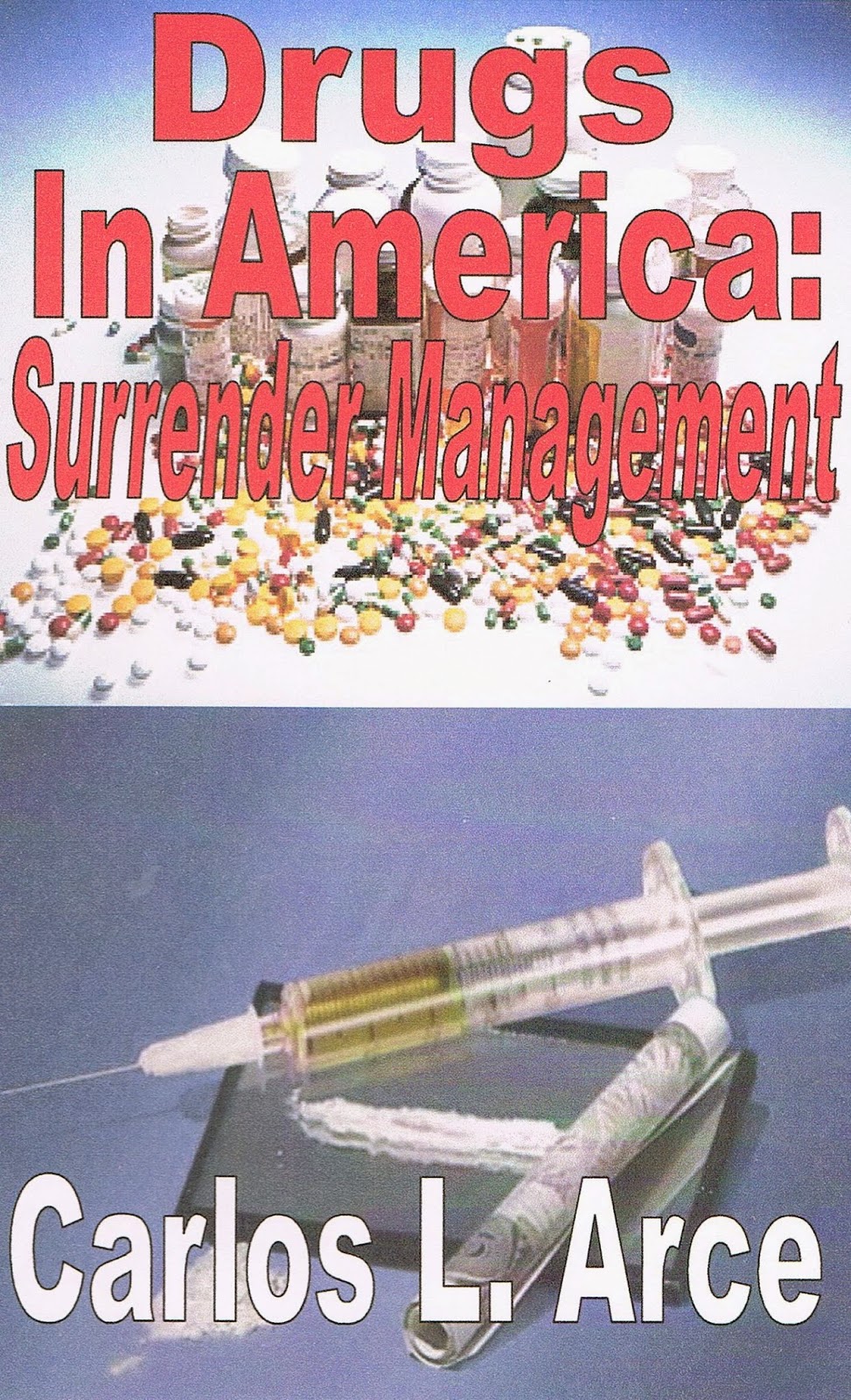
Surrender Management: Relative Morality

This writing states that the future of our successful society is intrinsically predicated on the outcome of our culture wars. The book touches on the nature of good and evil, the making of American general moral values, and the evolution of a multi-cultural America. It analyzes the growth of moral tolerance and how it continually pushes the limits, as well as the emergence of active secularism and moral relativism.

Many are the frightening questions we inevitably face: Will we continue to deny the poor credible police protection in their neighborhoods, adequate representation in our courts, and humane treatment in our prisons?  Will the battle over homosexual marriage and the rights of bisexuals morph into a debate over polygamy?  Will the argument over late-term abortion grow into a debate over how human is a baby in the first few months of life?  Will this generation of Americans continue to borrow and spend until only a bankrupt state is inherited by our children?

Intelligent people disagree on the causes and solutions to our dilemmas, or if there are any. Yet, Dostoyevsky's words continue to resonate with me: "If there is no God, everything is permitted."

www.CarlosArce.net

Relative Morality: Surrender Management at - http://ow.ly/MsMYG

Wednesday, April 15, 2015

American Jobs

Good American jobs are defined as those that have an American salary and carry American benefits.  The other jobs are those in other countries that pay less and offer fewer benefits.  The problem for Americans is that the lack of competition for good American jobs in yesteryears made our citizens educationally lazy, while disciplined Asian populations surged ahead in the knowledge competition.  Now we find that a good American job, European job, Japanese job, or Chinese job, or any other good job in the world will be auctioned off to the highest qualified applicant at the lowest price simply because Internet-based remote machine operations, teleconferences, virtual reality, and all the wonders of the cyber universe make it possible because it can be.


In the near future, a good job will be any available job in the world.  Americans are already getting used to being paid less for their work, as others around the world are delighted to be getting paid more.  Not too long from now, salaries will level off for everyone, and the dream world of a large middle class will be shared by many nations.  The question of how large will the American middle class be in the future is answered with another question; how fast will America fix its educational mess?

To download a copy of the book, follow the link below:

"Education Disaster in America": http://ow.ly/LFa6F

Please visit my website at www.CarlosArce.net

View the blog for other comments: http://carloslarce.blogspot.com/


Tuesday, April 14, 2015


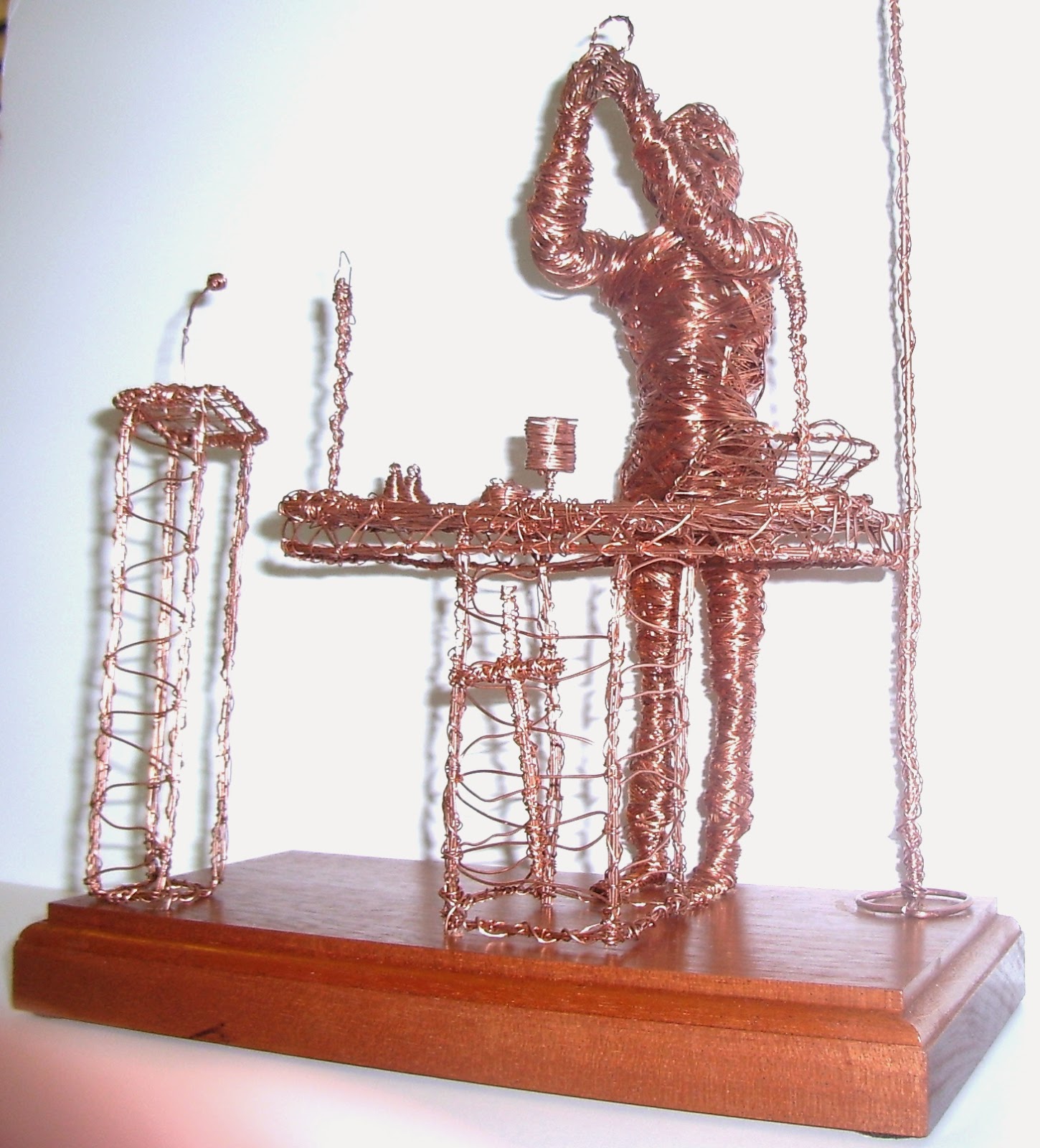
My Copper Statuettes

These are some of the copper wire statuettes I have made over time and continue to make today.  Some have already been sold in an art gallery and will be available in others in Fort Lauderdale, Miami, and Palm Beach.  They are also available online through Amazon.com. For more information, please visit my website with the following link:

www.CarlosArce.net


Tuesday, April 7, 2015

How Do You Try to Write About a War
    
     How do you try to write about a war? You don't; you just do. I am beginning to publish a seven-volume serial novel on the Vietnam War, Landing Zone. The first book is entitled "The Beginning."
        This novel is not an autobiography, although it is substantially autobiographical.  It is based on my own one-year tour as an airborne ranger and infantry sergeant with a Recon Platoon of the First Cavalry Division-Airmobile in the jungles of Vietnam and Cambodia.  I write about the things that I expe­rienced and the things that I saw, as well as what I was told by fellow sol­diers in Vietnam about what they had experienced and they had seen.  It is an accurate portrayal of a combat soldier in Vietnam.
        Each of the 38 chapters of the novel is interconnected through the protagonist's experiences; nevertheless, every chapter is designed to stand alone as a story with a beginning, middle, and end. Many serious and important issues about the Vietnam War are discussed or simply mentioned in the book as part of the plot, but the ultimate judgment is reserved for the reader.      
        There are over 500 photographs and some drawings and graphs, which are interspersed throughout the text of the novel to provide clarity and enhance understanding.  These visual aids have been selected from many thousands researched on the internet; they were deemed to be the most relevant and suitable for the particular story being told.  Photos or illustrations are used as an author’s creation, as public domain, or as “Fair Use” within the copyright rules of the United States.  They also serve to provide a parallel photo history of the war.
        I should finish publishing all seven books by the end of the summer. The first one is already available for digital download from Amazon.com for those of you interested in what really happened to America in Vietnam. 

Please share!

Visit my website at www.CarlosArce.net 

The following link is provided for the book in Amazon.com:   http://ow.ly/LjApm

Monday, March 30, 2015

America, a Drug Consuming Society

America, a Drug Consuming Society
        
 It is fair to say that America has a drug problem, and it is also fair to say that we are not the only ones in the world with a drug problem.  From time immemorial, the human race everywhere has had a drug abuse problem.  The issue is a matter of degree.  The societies in the United States and many countries in Europe, because of their unprecedented national wealth and their free society systems, have reached a very high level of drug abuse.  The abundance of disposable income available to the average individual in the United States provides them with the uncommon opportunity to afford the cost of frequent recreational drug use.  It is estimated that 60% of all illegal drugs produced in the world are consumed by Americans, who make up 5% of the world's population.
The rampant use of illegal drugs in our society has been substantially responsible for a host of major social problems, the general deterioration of social organization, and the weakening of the basic moral fiber of the nation.  The American people, like people everywhere in the free world, feel powerless and helpless in the face of a drug use epidemic throughout its entire society.  This is the one area of social crisis where people are most likely to say, “There’s nothing that can be done;” this is the one area where we have surrendered the most.  Surrendering is not an option; it is a suicide pact.  Our society has to fight back, but it has to fight smart.  It is not just a matter of tougher law enforcement and better prevention and treatment programs; a new winning strategy with a fundamental revamping of our national drug policy is in order.  The problem does not primarily stem from drug production abroad, and it is not happening because of our inability to detect the sale of hundreds of millions of little bags of dope on street corners; we need to look at our society's demand for drugs and at official corruption at home.  This book aims to suggest a new course of action.

Visit my website: www.CarlosArce.net

Download a digital copy 


Sunday, March 29, 2015

Individual Accountability and the National Debt

Individual Accountability and the National Debt

Is it seventeen or is it eighteen trillion dollars of national debt, which we will have following the next debt ceiling escalation? It is hard to keep track. The so-called “unfunded obligations,” which are measured in hundreds of trillions of dollars when state and municipal profligacy is factored in, are not accidental calamities but underhanded, back-door scrounging of national vitality. It’s useless to search for smoking guns; we are all to blame to some degree. It is the system that has failed; it has moved our population from abundance to complacency and dependence. Unions and associations concentrate political power and compel legislators to give evermore entitlements to their members. Ben Franklin warned that “when the people find they can vote themselves money, that will herald the end of the republic.” Citizens cry for more benefits for themselves while lamenting the crushing national debt. Political leaders struggle to balance patriotism against electoral reality.
People will not voluntarily give back excessive benefits, however undeserved, and pending congressional compromise over the method of fiscal suicide is no consolation. The “sine qua non” element is constitutional amendments. Universal respect for our constitution has been the essence of our national success, and it is the key to our future survival. Two specific constitutional amendments, “sanity amendments,” are desperately needed: a balanced budget amendment and a national debt repayment amendment. A balanced budget amendment would coerce partisans into sharing the dreadful but unavoidable national pain. Our country’s predicament is comparable to a recent movie called “127 Hours,” where a hiker gets one arm trapped by a fallen rock and is ultimately forced to cut off his own arm to survive.
Every citizen expects to get what they paid for, and rightfully so. It is a common misconception of retired Americans, however, that the Social Security and Medicare benefits that they now enjoy correspond to their previous contributions. Let’s begin by reporting a fair and honest accounting of every citizen’s contribution to the Social Security and Medicare entitlement programs. Let every person know what they put in, what a fair interest in that money has produced for them, and the total amount that in justice belongs to them. Let’s clearly pinpoint the end of everyone’s rightful compensation and the beginning of social charity. No person in need should be abandoned, but it begs the question, is anyone opposed to means-testing of deficit-financed social charity? We all have to accept that not all seniors are alike; some can pay their own way, while many more can partly contribute to their own retirement and medical costs.
A debt repayment amendment is never mentioned, and this is a major part of the problem. It is not enough to balance the budget over a number of years; the devastating debt we already have will zap our economy. A constitutional amendment will accomplish two very important things: it will create a debt repayment regime, and it will make it difficult for future legislatures to raise the national debt ceiling. A repayment regime would have to be designed as a generational, 75-100-year amortization plan. It would also require its own dedicated, tax-based revenue stream. Future augmentation of the national debt would not result from a painless stroke of the pen but from a corresponding increase in very public mandatory taxes.
A final consideration for fiscal responsibility is the need to prepare for massive national spending on domestic issues like failing schools, illegal immigration, overcrowded prisons, energy dependence, crumbling infrastructure …, as well as possible expenditures for international issues like a pending space race with China, growing military and humanitarian involvement in developing Arab revolutions, possible escalation of our war on terror … As a society, we can and have practice “surrender management,” it is the inevitable result of a refusal to sacrifice. Immunity from sacrifice is not an American entitlement.
Visit my website at:
www.carlosarce.net

Download a digital copy of this book at www.Amazon.com

Saturday, March 21, 2015

It’s Time for National Youth Service

It’s Time for National Youth Service

The most valuable and most underutilized American asset is our youth population.    The United States is not a small nation; in fact, it has the third largest population in the world, after China and India.  American youth between the ages of 18 and 24 exceeds 24 million citizens. We speculate that at least half of them are high school graduates, computer literate, physically healthy, and mentally stable. This would give us a large quality pool of no less than 12 million young Americans.

        We are facing a sad reality in America with the overall state of our youth when we judge by American standards.  Our national school dropout rate stands at 30%.  The figures are more distressing when we look at the dropout rate among minority youth, which is reported to be over 50%.  It becomes outright heartbreaking in some parts of the country, as is the case in New York City, where the school dropout rate among black youth is above 70%.  The American youth that does graduate from high school is, as a group, notoriously below international achievement levels for developed nations.   Other metrics of American youth are equally troubling.  In many ways much of our youth is disconnected from our society, mostly because we ask very little from it; it is the classic tyranny of low expectations.  Perhaps we can begin to require more of our youth, to whom much is given by our nation.

Conscription of youth into national service has existed in practically all societies in human history.  For us, it was last applied during the Vietnam War when 1.8 million young American men were called into military service.  At the end of the Vietnam War in 1975, and following a national trauma over massive youth anti-draft demonstrations throughout that War, our nation opted to discontinue the draft in favor of the creation of an all-volunteer army.  It was a capitulation to a rebellious segment of our youth and a clear example of surrender management in our government.

In times of war, our Army quietly suffers with insufficient manpower, using “stop loss,” the involuntary extension of soldiers’ enlistment agreements, to maintain manpower levels; over 50,000 of our troops have been subjected to this reprehensible “back-door draft.”  It is also disgraceful for our nation to require our soldiers to serve multiple combat tours while virtually all of our youth stay home, oblivious to our nation’s involvement in foreign wars and in an international anti-terrorism campaign.  America as a nation should bow its head in shame given the record numbers of suicides and post-traumatic stress disorder among our returning, multiple combat-tour serving troops, as well as among the neglected Vietnam veterans.  The real issue is not the legitimacy or morality of our present wars; it is the injustice and the foolishness of exempting our able young men from national service in times of war.  The Greek philosopher Aristotle suggested that the segregation of soldiers from society leads to unstable political order, while the more contemporary French thinker Jean Jacques Rousseau theorized that ending conscription precipitated the fall of the Roman Empire.  Our country is a good and great nation with many good qualities; granting our youth a “free lunch” is not one of them.

        We should create a national youth service program with the re-establishment of a lottery-based conscription system.  One specific proposal presented here is the creation of a National Service Auxiliary Corps (NYAC), which would operate in a quasi-military manner.  Recruits would train and reside in camps, and they would be relocated around the country as needed.  Units would be detachable to serve within regular government agencies, like police, schools, immigration, public health, social services, etc.  Let’s not think for a moment that the bulk of our youth would complain; they are waiting for an opportunity to become proud Americans.  Let’s call on them to help us stop saying that “nothing can be done” about our intractable problems; let’s once more become a united, “can do” nation.


Available for digital download from Amazon.com
The American Disconnected Youth

Visit my website
Carlos Arce Website